EBC and Island Peak Climbing | 19 Days Trek
Destination
Everest Solukhumbu Region
Adventure Type
Trekking Adventures
Difficulty Level
expert
Duration
19 Days
Trip Region
Everest region
Highest Altitude
6189m
Group Size
1-10+
Season
Autumn & Spring
EBC and Island Peak Climbing | 19 Days Trek
Overview
The Everest Base Camp and Island Peak climbing trek combines the epic EBC trek with the adventure of climbing a Himalayan peak. After a scenic drive to Ramechhap and a flight to Lukla (2 840 m), the trail passes through pine forests, suspension bridges, and Sherpa villages and reaches Namche Bazaar (3 440 m), the bustling centre of Khumbu. Daily hikes are five to seven hours long, and gradually become higher in alpine valleys and at high altitude.
Acclimatization Days in Namche and Dingboche are places that help acclimatize trekkers to the climb. A hike to the Everest View Hotel has sweeping panoramas of Everest, Ama Dablam, and Lhotse. The trail continues after Tengboche Monastery and Dingboche meadows to Lobuche (4 910 m). From Gorakshep, trekkers not only reach Everest Base Camp (5 364 m), but also climb Kala Patthar (5 545 m) to see the sunrise over the Himalayan giants.
The highlight is Island Peak (6,189 metres). From Base Camp,p the climb is on icy slopes, ladders, and fixed ropes as breathtaking views of Everest, Lhotse, and Makalu appear. It requires stamina, focus, and steady pacing - and guides and technical equipment. After the summit, the descent to Chukhung and from there to Namche is full of relief and celebration and unforgettable memories of the mountain.
Sherpa hospitality, sacred monasteries, and prayer flag-lined trails enhance the journey. Altitude changes set the pace - from pleasant valley strolls to difficult climbs. Nights are spent in warm lodges with simple rooms and hearty meals, whereas the hotels of Kathmandu offer comfort at the end of the trek.
Meals are full board, ranging from dal bhat to Sherpa specialities to familiar international meals. Tea and coffee breaks help to bring warmth to the crisp mountain air. Licensed guides, climbing Sherpas, and porters provide safety, confidence, and technical support to make this 19-day trek and climb a rewarding and unforgettable Himalayan adventure.
Trip Highlights
- Scenic drive to Ramechhap and flight to Lukla (2,840m), gateway to Khumbu, with trek through Phakding villages along the Dudh Koshi River.
- Trekking to Namche Bazaar (3,440m) across suspension bridges, pine forests, and lively Sherpa settlements.
- Acclimatization day in Namche with a hike to Everest View Hotel for wide Himalayan panoramas.
- Trekking to Tengboche (3,860m) and visiting its renowned monastery framed by Ama Dablam and Everest.
- Trekking to Dingboche (4,410m) and an acclimatization hike to nearby ridges (300–700m gain) for safe altitude adjustment.
- Trekking to Lobuche (4,910m) through alpine meadows and glacial valleys with views of Nuptse and Pumori.
- Trekking to Gorakshep (5,164m) and visiting Everest Base Camp (5,364m), set in the dramatic glacier landscape.
- Sunrise hike to Kala Patthar (5,545m) for close-up views of Everest and surrounding peaks.
- Trekking to Chukhung (4,730m) and onward to Island Peak Base Camp, preparing for the climb with technical gear.
- Climb to Island Peak summit (6,189m), challenging icy slopes with ropes and ladders, rewarded by sweeping Himalayan views.
- Trekking descent to Tengboche and Namche, enjoying Sherpa culture, monasteries, and prayer-flag-lined trails.
- Return through Lukla, completing the circuit with cultural immersion and scenic valley descent.
- Comfortable teahouses along the trail with hearty meals, hot drinks, and proper accommodation.
- Licensed guides, climbing Sherpas, and porters ensure safety, confidence, and technical support throughout the journey.
Itinerary
Package Cost Details
Included In Package
- Private airport pick‑up and drop‑off in a comfortable vehicle for hassle‑free transfers.
- Accommodation in Kathmandu hotels (twin‑sharing) and teahouses along the trekking route.
- Tent accommodation at Island Peak Base Camp during the climbing phase.
- Full board meals (breakfast, lunch, dinner) throughout the trek, with fresh fruits served after dinner.
- Professional English‑speaking trekking guide and licensed climbing Sherpa for technical support.
- Porter service (one porter for every two trekkers) to carry luggage.
- Salaries, equipment, and insurance for guides, Sherpas, and porters.
- Emergency assistance coordination (rescue costs covered by personal travel insurance).
- First‑aid kit carried by the guide and climbing Sherpa for safety.
- Trek completion certificate to celebrate your achievement.
- Required permits: Sagarmatha National Park Entry, Khumbu Rural Municipality Permit, and Island Peak Climbing Permit.
- Printed trekking and climbing route map for easy navigation.
- All applicable government taxes and official service charges.
Excluded In Package
- Travel insurance (mandatory for high‑altitude trekking, peak climbing, and emergency evacuation).
- Personal expenses such as hot showers, device charging, and Wi‑Fi in teahouses.
- Beverages: tea, coffee, bottled water, soft drinks, and alcoholic drinks.
- Personal trekking and climbing equipment (boots, jackets, poles, crampons, harness, helmet, ice axe, etc.).
- Tips for guides, climbing Sherpas, and porters.
- Expenses due to unforeseen events such as natural disasters, extreme weather, political unrest, or flight delays.
- Extra hotel stays and meals in Kathmandu before or after the trek (outside the package itinerary).
- Optional sightseeing tours in Kathmandu are not included in the trek package.
Trip Info
Everest Base Camp with Island Peak Climbing | 19 Days Trek Itinerary Overview
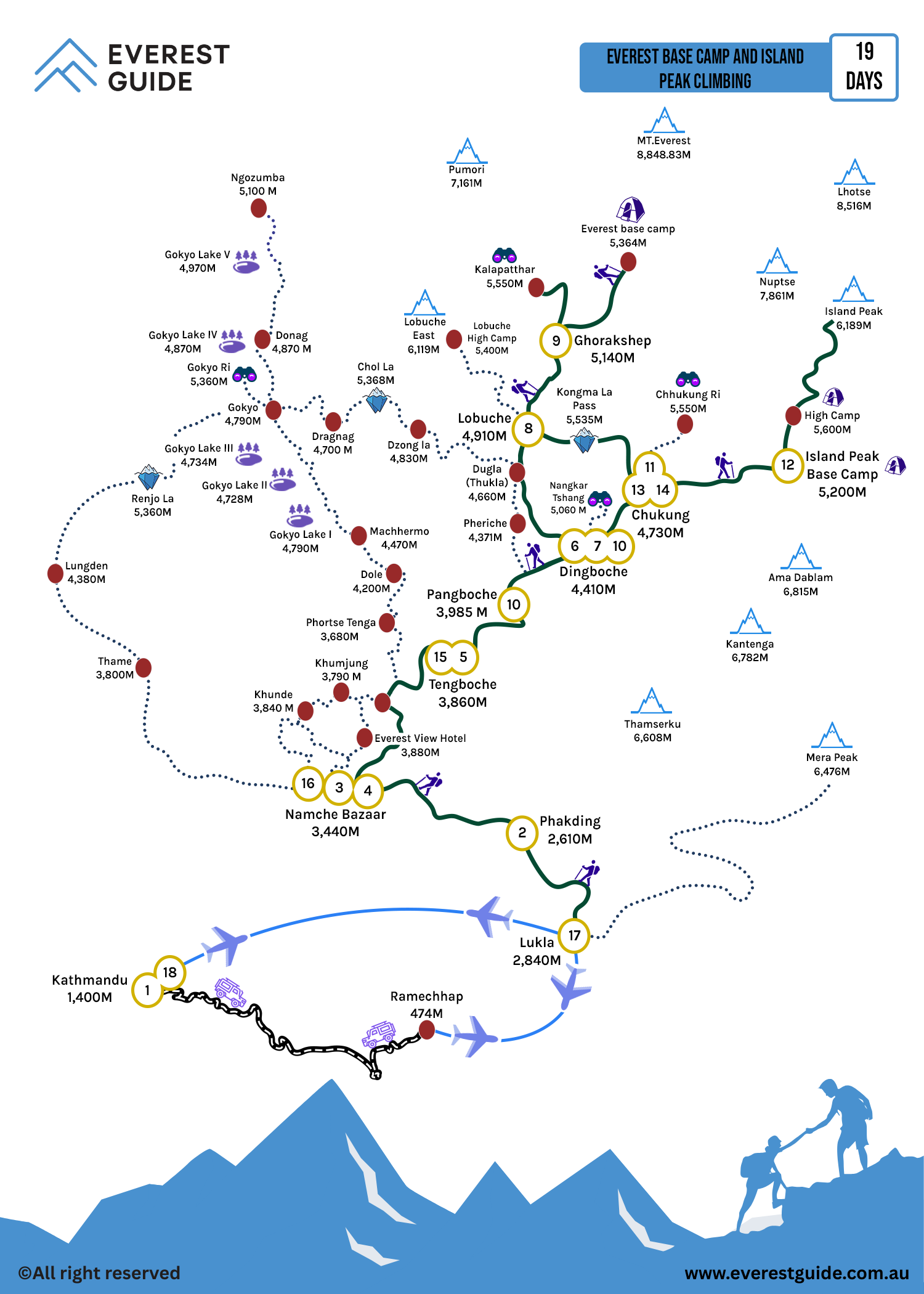
The Everest Base Camp and Island Peak climbing trek is a stunning 19-day trek through the Himalayas. It combines the world-famous EBC route with the challenge of summiting Island Peak (6 189 m). The adventure starts from Kathmandu with arrival and preparation, then drives to Ramechhap and a short flight to Lukla (2840 m). The first trek to Phakding takes three to four hours via riverside paths, suspension bridges, and Sherpa villages.
From Phakding, the trail goes to Namche Bazaar (3,440 meters). This six to seven-hour walk passes through pine forests and high bridges of the Dudh Koshi River. Namche provides acclimatization with the hike to Everest View Hotel (3880m), where the skyline is dominated by Everest, Ama Dablam, and Lhotse. Local bakeries, tea houses,s and Sherpa markets add the cultural flavor to the stay.
The route then leads on to Tengboche (3,560 m) with its famous monastery and then to Dingboche (4410 m). A second acclimatization day, with a hike to the adjacent ridges, where a gain of 300-700m in altitude is realized. Trekking on further to Lobuche (4,910m) with glacial valleys and views of Nuptse and Pumori. From Gorak Shep (5,164m), trekkers reach Everest Base Camp (5,364m) and climb Kala Patthar (5,545 m) at dawn for close-up views of Everest and surrounding peaks.
The climbing phase starts from the Island Peak Base Camp. With ropes, ladders, and the aid of climbing Sherpas, trekkers climb icy slopes to the top of Island Peak (6,189 m). The ascent is demanding in terms of stamina, concentration, and technical abilities, but pays back with sweeping panoramas of Everest, Lhotse, and Makalu. After the summit, there is a descent to Chukhung and on to Namche to provide relief, celebration, and cultural immersion.
Accommodation is in teahouses en route and tents at Base Camp. Meals are taken three times a day, ranging from Nepali dal bhat to Sherpa food such as thukpa and momos. Tea and coffee breaks with the comfort of the crisp mountain air. Licensed guides, climbing Sherpas, porters, and medical support make the adventure of a lifetime in the Himalayas safe and confident.
19 Days Everest Base Camp with Island Peak Climbing Trek altitude & distance coverage
|
Day |
Route |
Distance |
Duration |
Altitude Gain/Loss |
Sleep Altitude |
|
1 |
Arrival in Kathmandu, transfer to the hotel |
5.8 km |
25–30 min drive |
– |
1,324 m |
|
2 |
Drive Kathmandu → Ramechhap, flight to Lukla (2,840 m), trek to Phakding |
~8 km |
3–4 hrs |
↑ 286 m / ↓ 250 m |
2,610 m |
|
3 |
Trek Phakding → Namche Bazaar |
~10 km |
6–7 hrs |
↑ 830 m |
3,440 m |
|
4 |
Acclimatization in Namche, hike to Everest View Hotel (3,880 m) and return |
~3–4 km |
4–5 hrs (optional) |
↑ 440 m / ↓ 440 m |
3,440 m |
|
5 |
Trek Namche Bazaar → Tengboche |
~9 km |
5–6 hrs |
↑ 420 m / ↓ 260 m |
3,860 m |
|
6 |
Trek Tengboche → Dingboche |
~10 km |
5–6 hrs |
↑ 550 m |
4,410 m |
|
7 |
Acclimatization in Dingboche, hike to nearby hills (300–700 m gain) and return |
~4–5 km |
4–5 hrs |
↑ 300–700 m / ↓ 300–700 m |
4,410 m |
|
8 |
Trek Dingboche → Lobuche |
~8 km |
5–6 hrs |
↑ 500 m |
4,910 m |
|
9 |
Trek Lobuche → Gorakshep, hike to Everest Base Camp (5,364 m) and return |
~12 km |
7–8 hrs |
↑ 454 m |
5,164 m |
|
10 |
Hike Kala Patthar (5,545 m), return to Gorakshep, trek back to Dingboche |
~10–11 km |
6–7 hrs |
↑ 381 m / ↓ 635 m |
4,410 m |
|
11 |
Trek Dingboche → Chukhung |
~6 km |
3–4 hrs |
↑ 320 m |
4,730 m |
|
12 |
Trek Chukhung → Island Peak Base Camp |
~5 km |
3–4 hrs |
↑ 470 m |
5,200 m |
|
13 |
Climb Island Peak Summit (6,189 m), return to Chukhung |
~8–10 km |
8–10 hrs |
↑ 989 m / ↓ 989 m |
4,730 m |
|
14 |
Spare a day in case of bad weather on Island Peak |
– |
– |
– |
4,730 m |
|
15 |
Trek Chukhung → Tengboche |
~10 km |
5–6 hrs |
↓ 870 m |
3,860 m |
|
16 |
Trek Tengboche → Namche Bazaar |
~9 km |
5–6 hrs |
↓ 420 m |
3,440 m |
|
17 |
Trek Namche Bazaar → Lukla |
~18 km |
7–8 hrs |
↓ 580 m |
2,860 m |
|
18 |
Flight Lukla → Ramechhap, drive to Kathmandu |
– |
6–7 hrs |
↓ 1,536 m |
1,324 m |
|
19 |
Departure from Kathmandu |
– |
– |
– |
– |
Permits and Expenses for Everest Base Camp with Island Peak Climbing Trek
In order to complete the trek successfully, trekkers need to secure three permits: Sagarmatha National Park Entry Permit, Khumbu Pasang Lhamu Rural Municipality Permit, and Island Peak Climbing Permit. These fees cover conservation, safety, and local community development and regulate climbing activities in the Everest region.
Sagarmatha National Park Entry Permit
Access to the Everest region means that you have to have the Sagarmatha National Park permit. The fee contributes to the protection of the forests, glaciers, wildlife, and trail systems of this UN World Heritage site. Permits can be bought from the Nepal Tourism Board office in Kathmandu or from the park checkpoint in Monjo.
- Foreigners: NPR 3,000 per person (approx. USD 23)
- SAARC nationals: NPR 1,500 per person
- Nepali citizens: NPR 100 per person
- Children under 10: Free
Khumbu Pasang Lhamu Rural Municipality Permit
This local permit has replaced the old requirement of a TIMS card and is issued either from Lukla or Monjo before the main trekking routes. These fees from trekking aid in infrastructure, trail maintenance, and also development projects in the Khumbu region.
- Foreigners: NPR 2,000 per person (approx. USD 15)
- SAARC nationals: Same rate as foreigners
- Children under 10: Free
Island Peak Climbing Permit
Since the trek involves climbing Island Peak (6,189 meters), it requires obtaining a special permit from the Nepal Mountaineering Association (NMA). The fee covers regulation, safety, and environmental management for peak climbing. The permit is organized in Kathmandu before the trek starts.
- Spring season (March–May): USD 250 per person
- Autumn season (Sept–Nov): USD 125 per person
- Winter/Summer (Dec–Feb, Jun–Aug): USD 70 per person
Summary
For the Everest Base Camp with Island Peak Climbing Trek (19 Days), trekkers need:
- Sagarmatha National Park Entry Permit (NPR 3,000 for foreigners, NPR 1,500 for SAARC nationals).
- Khumbu Pasang Lhamu Rural Municipality Permit (NPR 2,000 for foreigners and SAARC nationals).
- Island Peak Climbing Permit (USD 250 in spring, USD 125 in autumn, USD 70 in off‑season).
- No TIMS card required.
These permits are essential for the trek, helping conserve natural resources and fund local
Trip Cost of the 19-Day Everest Base Camp with Lobuche Peak Climbing Trek Package 2026/2027
|
Group Size |
Price Per Person (USD) |
|
10 persons | |
|
10 – 20 persons | |
|
21+ persons | |
|
Single Supplement |
Note
- Prices are calculated on a per-person basis.
- For a group of 10 trekkers, the cost is fixed at a per-capita rate.
- For larger groups of 21 or more people, a discounted rate applies per person.
- An additional surcharge is applicable for private accommodation if you request a single room supplement.
- The package includes trekking services, climbing support, permits, meals, and accommodation as outlined in inclusions, with climbing-specific costs factored in community projects, and ensures safe peak climbing in the Everest region.
Best Time to Trek Everest Base Camp with Island Peak Climbing
The best seasons for the Everest Base Camp with Island Peak Climbing trek are Spring (March to May) and Autumn (September to November). These months have stable weather, there are clear skies, and conditions are safer for both trekking and climbing. The summer monsoon and winter months are not so favorable by virtue of heavy rain, slippery trails, or snowbound high camps.
Spring (March to May) | Prime Season for Trekking and Climbing
Spring is thought to be the best time to go on this adventure. Lower valleys abound with Rhododendrons, and the higher areas have pleasant temperatures and clear skies. March still may bring some light snow at Island Peak Base Camp, but April and May bring warmer days and great visibility of Everest, Lhotse, Makalu, and Ama Dablam. Longer daylight hours and stable ice conditions make spring the busiest climbing season.
|
Month |
Day Temp (°C) |
Night Temp (°C) |
Precipitation |
Weather Description |
Snowfall |
|
March |
0 to 10 |
-5 to -12 |
50–70 mm |
Cold mornings, clear skies |
Light at base camps |
|
April |
5 to 12 |
-2 to -8 |
70–90 mm |
Mild air, blooming valleys |
Rare |
|
May |
8 to 15 |
0 to -5 |
90–100 mm |
Warm days, stable climbing |
Minimal |
Autumn (September–November) | Best for Visibility and Stable Conditions
Autumn is another great season for trekking and climbing in the Everest region. September may start as a rainy month, but the trails quickly dried and the skies are clear. October brings crisp air, dead calm weather, and good climbing conditions on the Island Peak. November nights are cold, but the visibility is unowned and there are breathtaking views of the Himalayas from the top.
Month |
Day Temp (°C) |
Night Temp (°C) |
Precipitation |
Weather Description |
Snowfall |
|
September |
8 to 12 |
-2 to -8 |
120–150 mm |
Clear skies, occasional rain |
Light at altitude |
|
October |
5 to 12 |
-5 to -10 |
70–90 mm |
Crisp air, stable weather |
Rare |
|
November |
0 to 8 |
-8 to -15 |
40–60 mm |
Cold nights, superb visibility |
Begins at base camp |
Less Favorable Seasons
- Summer Monsoon (June–August): Heavy rainfall, muddy trails, landslides, and poor visibility make trekking and climbing unsafe.
- Winter (December–February): Freezing temperatures, snowbound base camps, and icy slopes often make Island Peak risky and difficult.
Packing List for Everest Base Camp with Island Peak Climbing Trek
General Essentials
- Expedition‑rated sleeping bag (–20°C, vital for Island Peak Base Camp nights)
- Heavy down jacket (for extreme cold above 5,000 m)
- Daypack 35–45L with rain cover
- Trekking poles (helpful for glacier approaches and steep descents)
- Water purification tablets/filter (for streams and lodge taps)
- Headlamp with spare batteries (essential for summit push starting before dawn)
Upper Body
- Sun hat or cap (UV protection at altitude)
- Warm beanie or wool hat
- Glacier sunglasses (category 4, mandatory for snow glare during summit climb)
- Buff/neck gaiter (for wind, dust, and cold protection)
Torso Layers
- Thermal base layers (moisture‑wicking for cold nights)
- 2 short‑sleeve trekking shirts
- 2 long‑sleeve trekking shirts
- Fleece jacket/pullover
- Waterproof shell jacket (windproof for high passes and summit day)
- Insulated mid‑layer jacket (critical for Island Peak climb and nights above 5,000 m)
Lower Body
- Thermal leggings/base layer
- 2 trekking pants (quick‑dry fabric)
- Hiking shorts (for lower valley days around Phakding and Namche)
- Comfortable lodge pants for evenings
- Waterproof shell pants (essential for glacier terrain and summit climb)
Hands
- Liner gloves
- Insulated waterproof climbing gloves (critical for summit day and icy sections)
Feet
- Warm wool socks (4–5 pairs)
- Trekking socks and liners
- Mountaineering boots (rigid sole, crampon‑compatible, broken‑in)
- Gaiters (for snow and glacier protection)
- Casual shoes/slippers (for teahouse evenings)
Undergarments & Sleepwear
- Quick‑dry underwear
- Sports bras (for women)
- Thermal sleepwear (essential for nights at Base Camp and Gorakshep)
Medicals & Personal Care
- First aid kit, altitude medication, pain relievers
- Oral rehydration salts (for hydration at altitude)
- Sunscreen SPF 50+, lip balm SPF (UV is intense above 5,000 m)
- Menstrual products (for women)
- Hand sanitizer, wet wipes, toiletries
- Personal prescribed medications
Climbing Gear (specific to Island Peak)
- Climbing harness
- Helmet
- Crampons (steel, adjustable to boots)
- Ice axe
- Carabiners and ascenders (provided by the climbing Sherpa, but personal fit recommended)
- Rope (group equipment usually supplied, but personal safety gear is advised)
- Jumar and belay device (often used on Island Peak’s fixed rope sections)
Electronics
- Power bank (10,000–20,000 mAh, charging is costly at altitude)
- Solar charger (useful at Island Peak Base Camp)
- Camera/smartphone with extra memory cards
- Adapter plug (Nepal standard: Type C/D/M)
Miscellaneous
- Trekking duffel bag (carried by porters)
- Lightweight towel
- Notebook and pen
- Snacks: energy bars, nuts, chocolates (extra calories for summit day)
- Reusable water bottle/hydration bladder (2–3L capacity)
- Small lock (for duffel bag security)
- Lightweight book/Kindle
Equipment and Extras Provided by the Company
- Down jacket (loaned for trekking and climbing days)
- Four‑season sleeping bag (loaned, suitable for high‑altitude nights and Island Peak Base Camp)
- Trekking duffel bag (70L, carried by porters)
- Everest Base Camp with Island Peak climbing route map
- Trekking T‑shirt (souvenir gift)
- Summit certificate after successful completion of the Island Peak climb and EBC trek
- First aid kit with oximeter for altitude monitoring and safety checks
- Basic medical support during the trek and climbing phase
Can You Do the Everest Base Camp andIsland Peak Climb Solo?
Solo trekking to Everest Base Camp with Island Peak climbing is not open to international travelers. Since 2023, it has been mandatory for all visitors to be guided by licensed guides of registered trekking agencies while in Nepal. This policy was introduced to ensure safety and to reduce the altitude risk, as well as to provide proper cultural and logistical support throughout the Khumbu region.
The itinerary includes reaching Everest Base Camp (5,364 m), hiking to Kala Patthar (5,545 m), and climbing Island Peak (6,189 m). These parts include technical climbing, glacier climbing, and careful acclimatization. Rope handling and fixed line use, along with emergency response, are taken care of by professional guides and climbing Sherpas, which allows the climb to be a safe and attainable experience.
For this reason, the 19-day Everest Base Camp with Island Peak Climbing trek is only available as a guided adventure. Travelling with guides ensures safe travel and adds to the trip with knowledge of Sherpa traditions, monasteries, and local life. Being a part of a group brings added encouragement and collective motivation to complete this strenuous expedition to a memorable Himalayan experience.
Meals and Accommodation on the Everest Base Camp with Island Peak Climbing Trek
Meals and accommodation for the Everest Base Camp with Island Peak Climbing trek are a combination of basic comfort of the Himalayan teahouses mixed with the expedition setup needed for peak climbing. This arrangement ensures that trekkers have enough food, warmth, and rest to cope with the physical demands of both trekking and climbing.
In Kathmandu, trekkers stay in 3-star hotels with twin or double rooms. Breakfast is included before and after the trek & there are modern facilities for comfort, hot showers, and preparation time.
Along the way, accommodation is in Sherpa teahouses. Rooms are basic with twin-shared beds and basic bedding. At lower villages like Phakding, Namche, and Tengboche, some lodges have attached bathrooms. In higher settlements such as Dingboche, Lobuche, and Gorakshep, bathrooms are communal, and facilities are more rudimentary because of remoteness.
At Island Peak Base Camp (5,200 m), the climbing phase is continued in tents. Sleeping bags with a working temperature of -20 degC are important. The atmosphere in the camp is more restful; there is a focus on hydration and preparing for the summit attempt.
Atmosphere: Teahouses provide warmth, the communal dining halls, and Sherpa hospitality. Evenings are spent around stoves, in the preparation of meals, and for the next day. At Base Camp, it is rougher, whereas expedition meals are made to conserve energy for climbing.
Meals
- Full board meals are provided daily: breakfast, lunch, and dinner.
- Traditional Nepali dal bhat (rice, lentils, vegetables) is complemented by Sherpa and Tibetan dishes such as noodles, soups, pasta, momos, thukpa, eggs, and Tibetan bread.
- Tea and coffee are served several times a day, with fresh fruit offered after dinner when available.
- At higher altitudes and at Base Camp, meals are simpler but calorie‑dense, designed to provide warmth and strength for demanding days like the Island Peak summit climb.
- Nutrition emphasizes carbohydrates for endurance, proteins for recovery, and plenty of fluids to aid acclimatization.
Notes
- Meals include Nepali, Sherpa, and Tibetan staples, with occasional international options in Namche and lower villages.
- Fresh fruit is served along the trail after dinner when available.
- Accommodation is twin/double sharing in teahouses, with attached bathrooms in lower villages and shared facilities higher up.
- Tent accommodation at Island Peak Base Camp is basic but functional, with expedition meals prepared by climbing Sherpas.
- This set‑up ensures trekkers are well‑fed, sleep in sound lodgings, and enjoy Sherpa hospitality while meeting the body’s needs for energy, hydration, and recovery during the trek and climb.
Visa and Entry Requirements for the Everest Base Camp and Island Peak Climbing Trek
Nepal Entry Visa
All foreign nationals need a Nepal entry visa to participate in the Everest Base Camp and the Island Peak climb. The visa can be obtained at the Tribhuvan International Airport in Kathmandu or in advance from Nepalese embassies abroad. A valid passport of at least six months duration and a passport-sized photo are required.
- 15‑day multiple‑entry visa: USD 30
- 30‑day multiple‑entry visa: USD 50
- 90‑day multiple‑entry visa: USD 125
Payment is usually made in cash (preferably in US dollars), but other major currencies are accepted.
Trekking and Climbing Permits
Apart from the Nepal entry visa, some permits are specific to the Everest region and the climbing section, which trekkers must obtain:
- Sagarmatha National Park Entry Permit (SNPEP): Required to enter the UNESCO‑listed Sagarmatha National Park. The fee supports conservation of forests, glaciers, wildlife, and trail infrastructure.
- Khumbu Pasang Lhamu Rural Municipality Permit: Introduced in place of the TIMS card, this local permit ensures direct contributions to community development, infrastructure, and trail maintenance in the Khumbu region.
- Island Peak Climbing Permit: Issued by the Nepal Mountaineering Association (NMA). This permit is mandatory for summiting Island Peak. Fees vary by season (USD 250 in spring, USD 125 in autumn, USD 70 in winter/summer).
Local Municipality Fees
The Khumbu Pasang Lhamu Rural Municipality Permit is collected at checkpoints such as Lukla or Monjo. This system guarantees that the trekking fees go directly to support Sherpa communities, trail maintenance, and bridges, as well as village facilities along the Everest Base Camp route.
Provided by Trekking Company
All required permits (trekking and climbing) are organised by the trekking company and are included in the package cost. This ensures adherence to the rules set up by the Government of Nepal and enables trekkers to concentrate on acclimatization, cultural interaction, and the adventure of reaching Everest Base Camp and climbing Island Peak.
Travel Insurance Requirements and Emergency Rescue Coverage for the Everest Base Camp with Island Peak Climbing Trek
Travel Insurance
Travel insurance is mandatory for the Everest Base Camp with Island Peak climb. Every participant must have a policy that specifically covers trekking and peak climbing at high altitudes (above 6,000 m).
A suitable insurance policy should include:
- Coverage for trekking and climbing above 6,000 m
- Helicopter rescue and emergency evacuation from remote camps
- Medical treatment and hospitalization for altitude sickness or climbing injuries
- Trip cancellations, delays, and repatriation costs
Emergency Rescue Operations
Rescue coordination is generally coordinated from Namche Bazaar, Lukla, or Kathmandu, depending upon the situation. In serious cases, helicopters are dispatched to higher points like Gorakshep, Dingboche, or Island Peak Base Camp. Guides and climbing Sherpas are responsible for communication with insurance providers and evacuation logistics, and can ensure medical support gets delivered promptly.
Weather and Risk Factors
Island Peak climbing exposes trekkers to unpredictable mountain conditions. Sudden snowfalls, strong winds, and freezing temperatures can make the climb to the summit a dangerous one. Insurance is, therefore, essential to cover possible delays, cancellations, and even emergency evacuations. Proper acclimatization, hydration, and guidance from experienced Sherpas will minimize risks, while insurance will provide financial and medical coverage in any unexpected worse condition.
Altitude Sickness and Prevention for the Everest Base Camp with Island Peak Climbing Trek
Professional trekking guides and climbing Sherpas carry medical kits, which include oximeters, to check on the oxygen level and identify the early signs of Acute Mountain Sickness (AMS). They also monitor the physical and mental state of trekkers and advise them to climb slowly, stay hydrated, eat balanced meals, and not to overexert themselves.
Altitude sickness is one of the major problems on this journey, particularly at Everest Base Camp (5,364 meters), Kala Patthar (5,545 meters), and the Island Peak summit push at 6,189 meters. These sections include thin air, cold temperatures, and challenging climbs. If AMS symptoms occur, the safest action would be to descend immediately. Helicopter evacuation can be arranged at short notice from villages like Dingboche, Gorakshep, or Island Peak Base Camp for transfers to hospitals in Kathmandu for treatment.
A good travel insurance policy is not an option; it's mandatory. Coverage needs to cover altitude emergencies, sudden weather changes in the Himalayas, and logistical complications. With proper acclimatization schedules, experienced Sherpas' guidance, and understanding the dangers of altitude, trekkers can minimize the dangers and enjoy a safe, rewarding, and unforgettable Himalayan adventure.
Personal Expenses to Budget For on the Everest Base Camp and Island Peak Climbing Trek
Trekkers and climbers should expect to bear small personal expenses not included in the package. Carrying an extra amount of cash helps to keep the trip smooth and enjoyable.
Snacks and Beverages: Trekkers usually purchase snacks - chocolate, nuts, energy bars - to keep them energized on long days. Bottled water and boiled water are sold, but many use purification tablets. Teahouses sell tea, coffee, and soft drinks, and shops in Namche and Lukla also sell alcohol and baked goods. These costs are not included,d so budget for these separately.
Teahouse Facilities: Basic facilities are included; additional services such as Wi-Fi, hot showers, and charging stations are available. Prices increase with altitude, particularly at Dingboche, Lobuche,e and Gorakshep. At Island Peak Base Camp, facilities are very basic, so be prepared for simple living conditions.
Souvenirs and Cultural Spending: There is a Namche Bazaar and Lukla selling handicrafts, prayer flags, clothes made from yak wool, and Sherpa souvenirs. Small donations at monasteries or cultural sites make the experience better but require additional cash.
Tips for Staff: It is traditional to tip guides, climbing Sherpas, and porters; plan for this. Carry small denominations of Nepali rupees, as ATMs are not reliable or are not available in rural areas.
By putting up money for such expenses, trekkers can avoid financial stress and understand how to enjoy a comfortable, peaceful Everest Base Camp and Island Peak climb.
Why Trek the Everest Base Camp with Island Peak Climb with Us?
Embark on the adventure that combines the excitement of high altitude trekking and rich culture to discover the Everest Base Camp and Island Peak Climbing adventure. From your arrival in Kathmandu to the 6,189-meter summit of Island Peak, our licensed guides and climbing Sherpas have your best interests at heart and make sure that you have a safe and well-paced Island Peak climb journey, full of the true local flavor.
We offer a well-thought-out 19-day itinerary balancing acclimatization, health, and climbing preparation. Our team is comprised of local experts who share insights into Sherpa traditions and monasteries and Himalayan life. Climbing Sherpas provide hands-on instruction in rope handling, use of crampons, and glacier travel techniques to prepare you for the summit push.
The departures are guaranteed,d and the schedules are flexible to suit groups of any size. The package is all-inclusive - this includes permits (Sagarmatha National Park, Khumbu Municipality, Island Peak Climbing Permit), domestic flights, accommodation, meals, guides, porters, and climbing gear support. This allows trekkers to be focused on the trail, the climb,b and the experience, not logistics.
For those who would like to enhance their journey even more, we can organize cultural walks to Khumjung village or monastery visits along the way. Optional helicopter sightseeing flights over Everest, Lhotse, and Ama Dablam are also available at extra charges, giving breathtaking views of the Himalayas from above.
Everest Guide Treks Agency has established a strong reputation for professionalism, care, and safety. We are well-equipped to handle larger groups with assistant guides and porters, and ensure smooth logistics and attention to the group throughout the trek and climb. With us, your adventure to Everest Base Camp and Island Peak is not just a trek; it is an achievement of a lifetime, a Himalayan adventure.
Map Info