Everest Base Camp Trek Overnight at Base Camp
Destination
Everest Solukhumbu Region
Adventure Type
Trekking Adventures
Difficulty Level
hard
Duration
15 Days
Trip Region
Everest Region
Highest Altitude
5550m
Group Size
1-20+
Season
Autumn & Spring
Everest Base Camp Trek Overnight at Base Camp
Overview
The Everest Base Camp Trek with a stay in the base camp is a unique and unforgettable trip, as the trail is a mix of cultural immersion, a slow acclimatisation process, and the excitement of being able to sleep at the foot of the highest peak in the world. It starts in Kathmandu, where the vibrant capital introduces a range of temples, courtyards, and colourful streets. It is then a short flight, or you can drive to Ramechhap and then fly to Lukla. Lukla provides access to the Khumbu region. Where nature and majesty converge with himalayan culture.
The steps lead you further into the Himalayas, with the scenery changing to green forests and the introduction of rocky paths and glacial moraines. Local Culture adds interest to the trip by passing through Namche Bazaar, the vibrant centre of Sherpa life, and Tengboche with its popular monastery. Monks chanting, using prayer flags, mani stones, and mountaintop air at once are all reminders that you are partaking in the same spirit of this trek as you are on a mountain adventure. The Sherpa hospitality, the traditional food, and the centuries-old traditions are beside you throughout the road, and the cultural experiences of this tour are as great as the landscape.
The expedition peaks at Kala Patthar, 5,545m, where the sunrise bathes Everest and surrounding monsters in pure yellow light. The Khumbu Icefall and oversized mountains, in turn, encircle the Everest Base Camp, which is located at 5,364m. It is a once-in-a-lifetime experience to spend the night here; the landscape of the glaciers, the beauty of the stars, and the immense size of the mountains all make it an experience that cannot be forgotten. The trek from Kathmandu to the foot of Everest is a blend of all three: landscape, culture, and altitude, one of the most iconic trekking journeys in the world.
Everest Guide Trek will help you in the discovery of this dramatic nature and basecamp heaven by making sure you have good transfers, cosy stay, and well-planned flights to Lukla. Starting with Kathmandu, our team will take care of your transfers, stay, and a properly arranged flight to Lukla. Everest Guide Trek will make the task easy with well-planned acclimatisation programs, quality lodges, and medical support, and the night stay at the Everest Base Camp will be memorable with this. With their commitment, you are guaranteed to experience the landscapes, culture, and adventure with peace and assurance.
Trip Highlights
- Travelling by air from Kathmandu to Lukla and starting the trek along pine forested and Riverside trails to Phakding.
- Passing through suspension bridges and ascending steadily to Namche Bazaar at 3,440m, where the first clear sight of Everest can be seen.
- Taking time to acclimatise in Namche, but hike to the Everest View Hotel and have sweeping panoramas of the Everest, Lhotse and Ama Dablam.
- Hiking back to the rhododendron woodlands and arriving in Tengboche, which is known for its monastery and spiritual atmosphere.
- Hiking to the expansive valley of Dingboche, with spectacular mountains and open scenery.
- Diving into the nearby ridges of Dingboche during acclimatisation in anticipation of the further altitudes to come.
- Going on through Lobuche within glacial moraines, having impressive scenes of Nuptse and Pumori.
- Sharing the Sherpa culture and hospitality on the road, with warm lodges, traditional meals, and very real mountain goodness.
- Arriving in Gorakshep and walking to the Everest Base Camp at 5364m, as you rest over the Khumbu Icefall under the stars.
Itinerary
Package Cost Details
Included In Package
- Arrival and departure assistance with comfortable cars.
- Lodging in regular lodges during the trek and hotels in Kathmandu (twin sharing basis).
- Breakfast, lunch, and dinner during the trek, tea/coffee, and seasonal fruits after dinner.
- Knowledgeable, English-speaking professional trekking guide, experienced and familiar with Sherpa culture.
- Porter service (one porter per two trekkers) to luggage haulage.
- Guide and porter salaries, equipment, and guide and porter insurance.
- Coordination of emergency rescue (travel insurance of trekkers will cover the rescue)
- A simple first-aid kit that the guide should have in case they need altitude and minor health assistance.
- Trek completion certificate to commemorate and celebrate your delight in your achievement of an overnight stay in the Everest Base Camp.
- Permits needed: Sagarmatha National Park Permit and Khumbu Rural Municipality Entry Permit.
- Trekking route map printed to be used in navigation and as a general map of the journey.
- Domestic flights: Kathmandu -Lukla (return)
- Any taxes and official charges of the government.
Excluded In Package
- Travel insurance (compulsory in the case of high-altitude trekking and evacuation insurance in case of an emergency)
- Personal costs when on the trek, i.e., hot showers, device charging, and lodge Wi-Fi.
- Drinks of all types (tea, coffee, bottled water, soft drinks, alcoholic drinks, etc.) are not part of the package.
- Individual trekking gear and equipment (boots, jackets, poles, sleeping bags, and so on) to be carried by the trekkers.
- Guides and porters (not included in package fee) tips.
- Costs payable to situations that are unpredictable, like natural disasters, extreme weather, political unrest, or flight delays.
- Hotel and food before and after trek (not included in package) Kathmandu.
- There are no sightseeing or tours of Kathmandu that are not listed in the trek itinerary.
Trip Info
EBC Trekking Overnight at Base Camp 15 Days – Itinerary Overview
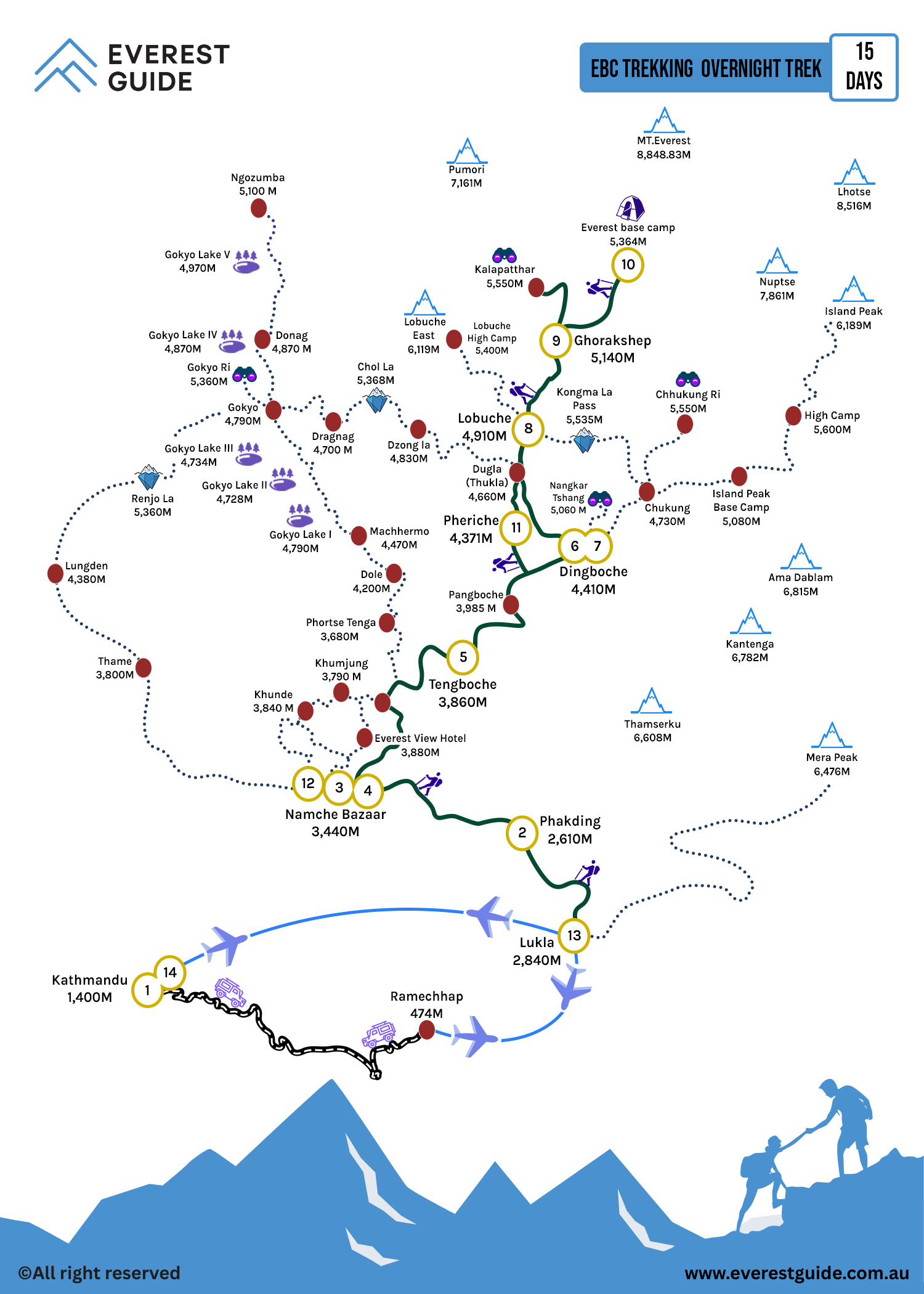
The Everest Base Camp Trek and an overnight stay at the base camp is a 15-day adventure. The expedition is a combination of nature, culture, and the excitement of camping at the base of the tallest mountain in the world. You will start in Kathmandu and be warmly welcomed in the colorful capital and then you will drive to Ramechhap, where you will take a flight to Lukla, 2,840m. The initial trek to Phakding at 2,610m is through river and pine forest trails, which prepares you to the rhythm of the trek. This path then leads progressively up to Namche Bazaar at 3,440m, the bustling Sherpa capital.
The acclimatisation day at Namche also involves a walk to the Everest View Hotel, which is 3880m. It provides a balance between rest and light exercising and panorama views of Everest, Lhotse, and Ama Dablam boost your morale. Of further on, there is a spiritual peace at Tengboche monastery and vastly expansive valleys in Dingboche lead to the magnificent scenery of Ama Dablam and other mountain giants. Acclimatisation rises on other ridges get you ready for the height to come, and make you wait and wonder how many mountains are between you.
Lastly, the path passes across glacial moraines to Lobuche and Gorakshep where the best is waiting. You are at the base camp of Everest, 5364m above sea level, and you have the night with no one around you, not a cell phone, no stars. In the next morning, a trek to Kala Patthar at 5545m allows a glimpse of Everest in golden sunrise, a golden moment of pure wonder. Going down through Sherpa villages, you not only bring back the memory of landscapes and altitude but the warmth of culture and the privilege of few, of sleeping at the foot of Everest itself.
This 15-day Everest Base Camp hike with an overnight stay is a unique combination of phenomenal scenery, Sherpa culture, and high adventure. It provides the full Himalayan package, with its fertile valleys and glacial, with time to acclimatise and feel at one with the mountains. Spending time at the base camp is a special touch that makes the experience both difficult and memorable. It is ideal for individuals who want to experience the real spirit of Everest and the reward of being and having a rest at its very feet.
Everest base camp trekking, overnight at base camp, altitude, and distance coverage
|
Day |
Route |
Distance |
Duration |
Altitude Gain/Loss |
Sleep Altitude |
|
1 |
Arrival in Kathmandu, transfer to the hotel |
– |
– |
– |
1,400 m |
|
2 |
Drive Kathmandu → Ramechhap, flight to Lukla (2,840 m), trek to Phakding |
~8 km |
3–4 hrs |
–230 m |
2,610 m |
|
3 |
Trek Phakding → Namche Bazaar |
~10–11 km |
6–7 hrs |
+830 m |
3,440 m |
|
4 |
Acclimatization in Namche, hike to Everest View Hotel (3,880 m) and return |
~3–4 km |
3–4 hrs |
+440 m / –440 m |
3,440 m |
|
5 |
Trek Namche Bazaar → Tengboche |
~9 km |
5–6 hrs |
+420 m |
3,860 m |
|
6 |
Trek Tengboche → Dingboche |
~10 km |
5–6 hrs |
+550 m |
4,410 m |
|
7 |
Acclimatization in Dingboche, short ridge hike, and return |
~4–5 km |
3–4 hrs |
+400 m / –400 m |
4,410 m |
|
8 |
Trek Dingboche → Lobuche |
~8 km |
5–6 hrs |
+500 m |
4,910 m |
|
9 |
Trek Lobuche → Gorakshep (5,164 m), evening hike to Kala Patthar (5,545 m) |
~12 km (round trip) |
7–8 hrs |
+635 m / –270 m |
5,164 m |
|
10 |
Trek Gorakshep → Everest Base Camp (5,364 m), overnight at EBC |
~4 km |
3–4 hrs |
+200 m |
5,364 m |
|
11 |
Trek Everest Base Camp → Pheriche |
~12 km |
6–7 hrs |
–950 m |
4,240 m |
|
12 |
Trek Pheriche → Namche Bazaar |
~14 km |
6–7 hrs |
–800 m |
3,440 m |
|
13 |
Trek Namche Bazaar → Lukla |
~16 km |
6–7 hrs |
–600 m |
2,840 m |
|
14 |
Flight Lukla → Ramechhap, drive to Kathmandu |
– |
– |
– |
1,400 m |
|
15 |
Departure or onward activities |
– |
– |
– |
– |
Permits and Expenses Needed for the EBC Trekking Overnight at Base Camp | 15 Days
Two permits are necessary to walk to Everest Base Camp with the special overnight experience. The revenues are used to conserve, safeguard, and develop the Khumbu region and Sherpa communities sustainably.
Sagarmatha National Park Entry Permit
This is a permit that allows access to the region of Everest, which is a UNESCO World Heritage region. The revenue earned is used to preserve forests, wildlife, glaciers, and trekking routes.
- Foreigners: NPR 3,000 per person (approx. USD 23)
- SAARC nationals: NPR 1,500 per person
- Nepali citizens: NPR 100 per person
- Children under 10: Free
There are options to get it at the Nepal Tourism Board office in Kathmandu or at the Monjo checkpoint.
Khumbu Pasang Lhamu Rural Municipality Permit
This domestic permit funds the trails, infrastructure, and development of the Sherpa community. It has taken over the previous TIMS card system.
- Foreigners: NPR 2,000 per person (approx. USD 15)
- SAARC nationals: Same rate as foreigners
- Children under 10: Free
- Issued in Lukla or Monjo.
TIMS Card (Trekkers’ Information Management System)
The Khumbu permit already includes the requirement of the Everest region, and therefore, the TIMS card is not required in this trek.
Summary
In the case of the Everest Base Camp Trekking Overnight at Base Camp (15 Days), you will require:
- Sagarmatha National Park Entry Permit (NPR 3,000 for foreigners, NPR 1,500 for SAARC nationals)
- Khumbu Pasang Lhamu Rural Municipality Permit (NPR 2,000 for foreigners and SAARC nationals)
- No TIMS card required
These permits ensure the trek is properly managed, the environment is protected, and local Sherpa communities benefit directly from tourism and conservation efforts
Trip Cost for EBC Trekking Overnight at Base Camp (15 Days) | 2026/2027
|
Group Size |
Price Per Person (USD) |
|
10 persons | |
|
10 – 20 persons | |
|
21+ persons | |
|
Single Supplement |
Note
- The prices are calculated on a per-capita basis:
- In the case of ten trekkers, it will be a flat per-capita fee.
- When there are bigger groups of twenty and above, a discounted rate is applied on a person basis.
- The package will cover accommodation in the lodge when trekking and hotels in Kathmandu where people can relax.
- During the trek, all the meals are offered, tea, coffee, and seasonal fruits after dinner.
- Another special feature of this package is that it includes an overnight stay in the Everest Base Camp (5364 9 m) to which the price is already included.
- There is an extra fee to be paid in case of the request for private accommodation.
Best Time to Trek EBC with Overnight Stay at Base Camp
Spring (March to May) | Ideal for Overnight at Base Camp
The most common season in the Everest Base Camp trek, involving an overnight stay, is during spring. It is a pleasant climate, cool in the morning, and the rhododendrons are in blossom on the lower walks, which helps to give interest to the expedition. The view is fantastic, and mountains such as Everest, Lhotse, and Ama Dablam are brightly lit with clear skies. Spending a night at base camp during spring is a magical experience because starlit skies are quite safe and make the experience memorable.
|
Month |
Day Temp (°C) |
Night Temp (°C) |
Precipitation |
Weather |
Snowfall |
|
March |
0 to 10 |
-5 to -10 |
40–60 mm |
Cold mornings, clear skies, stable trekking |
Light at higher ridges |
|
April |
5 to 12 |
-2 to -8 |
60–80 mm |
Mild days, rhododendrons blooming, comfortable evenings |
Rare |
|
May |
8 to 15 |
0 to -5 |
80–90 mm |
Warm, clear skies, stable trails, cozy nights at base camp |
Minimal |
Autumn (September to November) | Clear Skies and Festive Atmosphere
The other ideal season for an overnight trek is autumn. The monsoon rain purifies the atmosphere and creates crystal clear skies with clear views of Everest and other surrounding mountains. The weather is moderate, and trekking is comfortable, and the weather is festive with lots of trekkers on the trail. It is especially pleasant to spend the night at base camp in the fall when the air is clear, the weather is predictable and safe, and the mountain views are memorable.
|
Month |
Day Temp (°C) |
Night Temp (°C) |
Precipitation |
Weather |
Snowfall |
|
September |
6 to 12 |
-2 to -6 |
70–100 mm |
Fresh air after monsoon, crystal views, lively lodges |
Occasional at higher passes |
|
October |
5 to 10 |
-3 to -8 |
40–60 mm |
Peak season, clear skies, vibrant trekking mood |
Rare |
|
November |
0 to 8 |
-5 to -10 |
20–40 mm |
Crisp mornings, stable weather, warm hospitality |
Light at higher ridges |
Summer Monsoon (June–August)
During summer, heavy rains make the trek uncomfortable. Roads go bad and greasy, landslides increase, and visibility is hidden. Unstable tracks and leeches make the route more challenging, and despite staying at a base camp overnight, the expedition is not as pleasant in case of unpredictable weather.
Winter (December–February)
Winters are associated with freezing temperatures, snow-covered trails, and icy wind,s which make accessing the base camp a risk. There is a risk of altitude sickness and cold, and the nights in the base camp can be very severe. Lodges are still cozy, but the severe weather restricts comfort and safety, and, therefore, winter does not make the overnight trek so comfortable.
Summary:
The Everest Base Camp Overnight Trek is best done during Spring (March-May) and Autumn (September-November). Both are relatively predictable in terms of weather, clear skies, and ability to spend the night in base camp, so the trekkers enjoy the majesty of everest in the stars without any inconveniences and cultural comfort in the path.
Packing List for the EBC Trekking Overnight at Base Camp | 15 Days
General Essentials
- Four-season sleeping bag (down to -20C, needed to sleep at Base Camp; lodges provide blankets, but a personal sleeping bag is always warm)
- Heavy down jacket (essential on cold nights in Lobuche, Gorakshup and Base Camp Overnight stay)
- Daypack 35‑40 L with rain cover
- Trekking poles (useful in steep ascents, suspension bridges, and glacier walking).
- Purification pills (or portable filter) of water (streams and lodge refills).
- Headlamp and backup batteries (must-have when on the Base Camp, night and early morning hikes)
Upper Body
- UV protection sun hat or cap
- Warm hat/beanie (in case it is cold in the mornings at Gorakshup and Base Camp)
- UV -covered sunglasses (category 3-4, snow and ice glare are strong)
- Buff or neck gaiter (dust, wind, and cold protection)
Torso Layers
- Base layer that is technical (thermal, moisture -wicking)
- 2 short‑sleeve trek shirts
- 2 long‑sleeve trek shirts
- Fleece jacket/pullover
- Jackets Waterproof shell jacket (windproof on Lobuche and Base Camp)
- Mid-layer jacket (to be worn when freezing at night, nights above 5,000 m), insulated.
Lower Body
- Thermal leggings/base layer
- 2 hiking pants (quick‑dry)
- Hiking pants (when hiking in the lower valley at Phakding and Namche)
- Cosy lodge pants (evening in lodges)
- Rain/snow shell pants (when the weather is unpredictable, and it may be high altitudes)
Hands
- Liner gloves
- Waterproof gloves that are insulated (very important during Base Camp Overnight and Kala Patthar sunrise walk)
Feet
- Warm wool socks (4-5 pairs, additional ones will be used at night in Base Camp and Kala Patthar)
- Hiking socks and liners
- Waterproof trekking shoes (worn in, ankle protection requiring glacier country)
- Trainers/slippers (when visiting the lodge in the evening)
Undergarments & Sleepwear
- Quick‑dry underwear
- Sports bras (for women)
- Thermal sleeping suit (essential requirement in Base Camp overnight and Gorakshup stay)
Medicals & Personal Care
- First aid kit, altitude drug, pain killers.
- Oral rehydration salts (hydration in the highlands)
- Sunscreen SPF50 +, lip balm SPF(UV is high above 3 500 m).
- Women menstrual items (women).
- Hand sanitizer, wipedown, toiletries
- Prescribed personal medications.
Electronics
- Power bank (15,000-20,000 Follows expensive at an elevation level.
- Base Camp and Kala Patthar view Camera or smartphone with additional memory cards.
- Adapter plug (Nepal standard: Type C/D/M)
Miscellaneous
- Trekking duffel bag
- Lightweight towel
- Notebook and pen
- Snacks: power bars, nuts, chocolates (additional energy to Base Camp overnight)
- Reusable hydration bladder/ water bottle (2-3L)
- Lock (duffel bag security) small.
- Lightweight book/Kindle
Equipment and Extras Provided by the Company
- Down jacket (loaned for trek)
- Sleeping bag (loaned, Base Camp overnight conditions). Lodges offer additional blankets.
- Trekking duffel bag (70 L, to be used by porters)
- The trekking route to Everest Base Camp.
- Trekking T‑shirt (souvenir)
- Appreciation certificate at the end of the trek.
- First aid kit with an oximeter to check on altitude.
- Simple medical assistance throughout the trek.
- Hotel stay on the trek, and Lodge stay at Kathmandu.
Can You Trek the EBC Overnight Trek Solo?
Foreign travelers are no longer able to walk to Everest Base Camp on their own. The government now needs licensed guides to accompany trekkers, to manage them safely and adequately, from 2023. The night ascent goes as high as 5,364 m, and the mountain peaks are steep, going through glaciers and thin air, which makes altitude sickness widespread. Individual hiking is not safe due to the changing weather and the need to address cases of emergency requiring expert help.
Guides control acclimatization programs, control health, and address danger, making the trip safe. They also enhance the adventure by describing Sherpa customs, monasteries, flags of prayer, and village life in Namche, Tengboche, Dingboche, and Lobuche. There are porters that help the trekkers to avoid overexerting and depleting their energy to reach Base Camp and Kala Patthar as lodges and camps present dishes and cozy shelter.
Group trekking will bring in confidence and companionship. Trekkers support one another, exchange experiences, and congratulate on achievements. The atmosphere is excited in Namche and determined in Dingboche, victorious in Base Camp, and in wonderment in Kala Patthar. The fight back to Kathmandu finishes the adventure in comfort and makes the strenuous trek a more rewarding Himalayan experience.
What are the Meals and Accommodation Like in the EBC Overnight Trek?
The Everest Base Camp Overnight Trek includes meals and accommodation options to ensure trekkers are well fed and rested even at very high altitudes over 5,000m. This is enhanced by an overnight stay at Base Camp, which is not a very common feature, demanding additional warmth and high-energy meals but providing a genuine Sherpa experience.
In Kathmandu
Trekkers are accommodated in good hotels and have a twin or a double room. A breakfast is provided before the trek and upon return. Kathmandu meals blend Nepali and international cuisine, and trekkers can experience the variety of dishes before venturing into the mountains.
Along the Trek
There is accommodation in lodges in lower and mid-altitude villages like Phakding, Namche, Tengboche, and Dingboche. The rooms are twin or double, with attached showers, and Wi-Fi in most lodges. Bakery cafes and lounges are comfortable and diverse. Facilities are more basic, but are still enhanced (in comparison with the regular teahouses) in higher villages such as Lobuche and Gorakshup, with warmer bedding and more hearty food. Even at the Everest Base Camp, trekkers stay overnight in expedition-like tents with sleeping bags and warm blankets to guarantee their safety and comfort.
Atmosphere
The trail has lodges that provide warmth, comfort, and Sherpa hospitality. Evening hours are spent in the dining rooms over the heaters or fireplaces, telling stories to their fellow trekkers. The spirit changes spontaneously, the Namche Bazaar is bustling, Dingboche is philosophical, Lobuche is purposeful, Base Camp is celebratory, and Kala Patthar is reverential. An overnight stay at Base Camp is a special touch of accomplishment since trekkers sleep under the shadow of the actual Everest.
Meals
The trek would be covered by full board meals: breakfast, lunch, and dinner every day.
- Breakfast: Porridge, eggs, pancakes, Tibetan bread, toast with jam or honey, hot drinks (tea, coffee, hot chocolate).
- Lunch: Dal bhat, noodles, soups, fried rice, pasta, and bakery items in Namche and Dingboche.
- Dinner: Sherpa stew, thukpa, momos, curried potatoes, and international comfort food. At higher altitudes such as Lobuche, Gorakshep, and Base Camp, meals are simpler but calorie-rich, designed to provide warmth and strength.
Tea and coffee are served several times throughout the day, and fresh seasonal fruit is served at dinner. Emphasis is laid on hydration, and at each lodge, boiled or purified water is present.
Health & Nutrition
Food is adjusted to altitude: high-carb foods are rich in energy, soups help to maintain hydration, and hot meals help to gain strength. Fresh fruit contains vitamins, and the hot drinks will keep the trekkers hydrated in cold and dry air. Guides recommend trekkers consume healthily and drink plenty of fluids to minimize the chances of altitude sickness.
Notes
Cuisine is a blend of Nepalese, Sherpa, Tibetan, and international cuisines. Bakery snacks are served at Namche and Dingboche. Breakfasts are full and cozy and accompanied by tea or coffee. There are twin or double rooms with attached bathrooms in the lower villages, improved lodges in mid-altitudes, and tents in the Base Camp. This arrangement provides trekkers with secure accommodation, nutritious meals, and Sherpa hospitality and breathtaking vistas of Everest, Lhotse, and Ama Dablam.
Visa and Entry Requirements for the EBC Overnight Trek | 15 Days
Nepal Entry Visa
All foreigners need a valid Nepal entry visa to do the Everest Base Camp Overnight Trek. The visa is either received upon arrival at Tribhuvan International Airport or prior to arrival at Nepalese embassies in foreign countries. It needs a passport with a minimum of six months' validity and a passport-size photograph.
- 15‑day multiple‑entry visa: USD 30
- 30‑day multiple‑entry visa: USD 50
- 90‑day multiple‑entry visa: USD 125
The payment is normally in cash, usually in US Dollars, though other major currencies are also accepted.
Trekking Permits
Besides the entry visa, trekkers are required to request a regional permit for the Everest area:
- Sagarmatha National Park Entry Permit (SNPEP): A permit is needed to visit the national park of Sagarmatha (UNESCO). Fees help in conserving forests, glaciers, wildlife, and trails.
- Khumbu Pasang Lhamu Rural Municipality Permit: It has been introduced as a replacement for the TIMS card. This area permit guarantees direct donations to the development ofthe Sherpa community, infrastructure, and trail conservation within the Khumbu region.
Local Municipality Fees
The rural municipality permit to Khumbu Pasang Lhamu is paid at roadblocks in Lukla or Monjo. This system guarantees that the trekkers contribute directly to the Sherpa communities, trail maintenance, bridge maintenance, and village development along the Base Camp trail.
Provided by Trekking Company
The trekking company arranges all the required permits, and charges are covered in the trek fee. This will reduce paperwork, help observe the rules of Nepal, and also enable the trekkers to concentrate on acclimatization, health, culture, and the experience of less than a night in the Everest Base Camp, which is rarely experienced. The support of the company makes the trip safe, well-managed, and fulfilling between Kathmandu and Kala Patthar and Base Camp.
Travel Insurance Requirements and Emergency Rescue Coverage for the EBC Overnight Trek
Travel Insurance
The Everest Base Camp Overnight Trek requires travel insurance. All trekkers are required to have a policy that would cover high-altitude trekking to 6,000 m. The hike reaches 5,364 m at Base Camp and 5,545 m at Kala Patthar, where the most frequent risks are altitude sickness, injuries, and unexpected weather changes. Unless there is valid insurance, one is not allowed to participate.
An appropriate insurance policy must contain:
- Trekking insurance up to 6,000 m.
- Helicopter rescue, emergency evacuation.
- Healthcare and hospitalization.
- Cancellation of trip, delay, and repatriation.
Emergency Rescue Operations
Co-ordination of rescue operations is done at Namche Bazaar, Lukla, or Kathmandu. When the need arises, the helicopters can fly to villages like Dingboche, Lobuche, Gorakshep, or even the Base Camp itself in a matter of seconds to either take the trekkers down to lower altitudes or to Kathmandu to hospitals. Guides facilitate communication with insurance providers and organize medical assistance in a short time.
Overnight Trek Considerations
A night spent at Base Camp exposes a person to more extreme cold and elevation, which further complicates the need to be covered by insurance. Potential problems should be known to Trekkers:
- Weather Delays: Intense weather may cause flights to be delayed by strong winds, heavy clouds, or snow.
- Altitude and Health- The high rate of helicopter falls may seem physically straining.
- Availability: The demand for helicopters is high during peak seasons, and thus, the schedules can change.
- Insurance Coverage: Helicopter evacuation should be a clear part of the policies because it is costly.
Note: Logistics are mostly done by guides and trekking agencies, yet trekkers have to be flexible. The Everest Base Camp Overnight Trek with proper insurance and good rescue cover can be a safe and enjoyable adventure, and the trekkers can get the rare privilege of sleeping at the base of the highest mountain on Earth.
Why Insurance Matters on the EBC Overnight Trek
The Everest Base Camp Overnight Trek is both longer and more challenging than most Himalayan trails and includes some days at altitudes over 4,000 m and a few days at the Base Camp itself, where the conditions are tough, and the health services are unavailable. Despite the lodges on the road, there are still dangers of being affected by altitude sickness, injuries, and sudden weather conditions.
Insurance gives one peace of mind. The rescue by helicopters, hospital care, or transport inconveniences can become extremely expensive. This is very dangerous to the trekkers, and a proper policy cushions them against such risks so that they are able to enjoy the adventure and the Sherpa hospitality without the worry of such emergencies. This trip must have coverage of high altitude trekking, evacuation, and medical services.
Through trusted insurance, the trekkers will be able to enjoy the success of stepping on the base camp of Everest at 5,364 m and Kala Patthar at 5545 m and even stay overnight at Base Camp. They also have the constant assistance of guides, porters, and rescue teams, thus making the difficult trek an easy and satisfying Himalayan experience.
Altitude Sickness and Prevention for the EBC Overnight Trek
One of the frequent difficulties with the Everest Base Camp Overnight Trek is altitude sickness. The route is 5364 m at Base Camp and 5545m at Kala Patthar. The risk of Acute Mountain Sickness (AMS) is increased by thin air, elevated altitude conditions, and extended days of the trek. An overnight stay in Base Camp introduces increased exposure to altitude, and prevention is even more critical.
Professional guides take medical kits equipped with an oximeter to measure oxygen levels and monitor the onset of early AMS. They advise trekkers to walk gradually, take lots of water, take balanced food, and take rest days in Namche Bazaar and Dingboche to acclimatize. In case of symptoms like headache, nausea, dizziness, or fatigue, the only safe way is to get down at once. Guides are trained at handling crises and can organize a helicopter rescue in villages such as Dingboche, Lobuche, Gorakshep, or even Base Camp.
The high altitude trekking and helicopter rescue require travel insurance to be mandatory. It covers trekkers against the excessive evacuation, medical treatment, and surprise accidents. By adequately acclimatizing, receiving professional guidance, and being aware of the dangers of elevation, the overnight trek can be safely completed, and trekkers can rejoice in the special privilege of being able to sleep at Everest Base Camp in the shadow of the tallest mountain in the world.
Personal Expenses to Budget For on the EBC Overnight Trek
The package contains most of the essentials, though you should add extras based on your requirements. Items you may want to buy include things like chocolate, nuts, and energy bars, or you can purchase tea, coffee, soft drinks, or alcoholic drinks in Namche Bazaar or any other village. Meals are included in the lodges, whereas Wi-Fi, hot showers, and charging of devices are usually extra, and the price increases with the altitude, such as in Dingboche, Lobuche, and Gorakshep. Namche and Tengboche also have souvenirs like prayer flags, yak wool clothing, and Sherpa handicrafts, and donations to monasteries are welcome.
Guides and porters are usually tipped; therefore, consider it in your budget. It is convenient to carry small notes in Nepalese Rupees as there are few and unreliable ATMs in the isolated parts. Flights between Kathmandu and Lukla are included, though the bad weather can cause delays, which can lead to additional expenditures on food or accommodation. You can have an easier time on the overnight trek and enjoy the unique experience of sleeping at the Everest base camp without worrying about money by preparing snacks, lodge extras, souvenirs, donations, and tips.
Why Trek the EBC overnight at Base Camp with Us?
Everest Guide Trek Trekking package to Everest Base Camp Overnight is a full-fledged Himalayan adventure mixed with safety and confidence. Our certified guides will bring you along to the last climb at Base Camp and Kala Patthar, making sure that the pacing, acclimatization, and cultural understanding are in order step by step. The infrequent overnight stay in Base Camp is well organized with expedition-style tents, warm sleeping bags, and healthcare facilities, and therefore, you do not have to worry about sleeping in Base Camp at 5,364 m with a dark and ominous Everest looming over them.
We offer a prepared 15-day itinerary, which is the most balanced between acclimatization and comfort. The package is complete; it includes permits, lodges, meals, guides, and porters. Lower-altitude lodges have attached bathrooms, hot showers, Wi-Fi, and comfy dining halls, and improved facilities in higher-altitude villages make them warm and safe. We use reliable operators to ensure safe air operations, and in the event of an emergency, our agency provides evacuation options. Our professional assistant guides and porter services are efficient to manage logistics of all group sizes. When one decides to go with Everest Guide Trek Agency, the only thing to do is to not only reach Base Camp, but also spend the night there under the care of a well-organized and fully equipped agency, rich in culture and full-fledged care.
Map Info